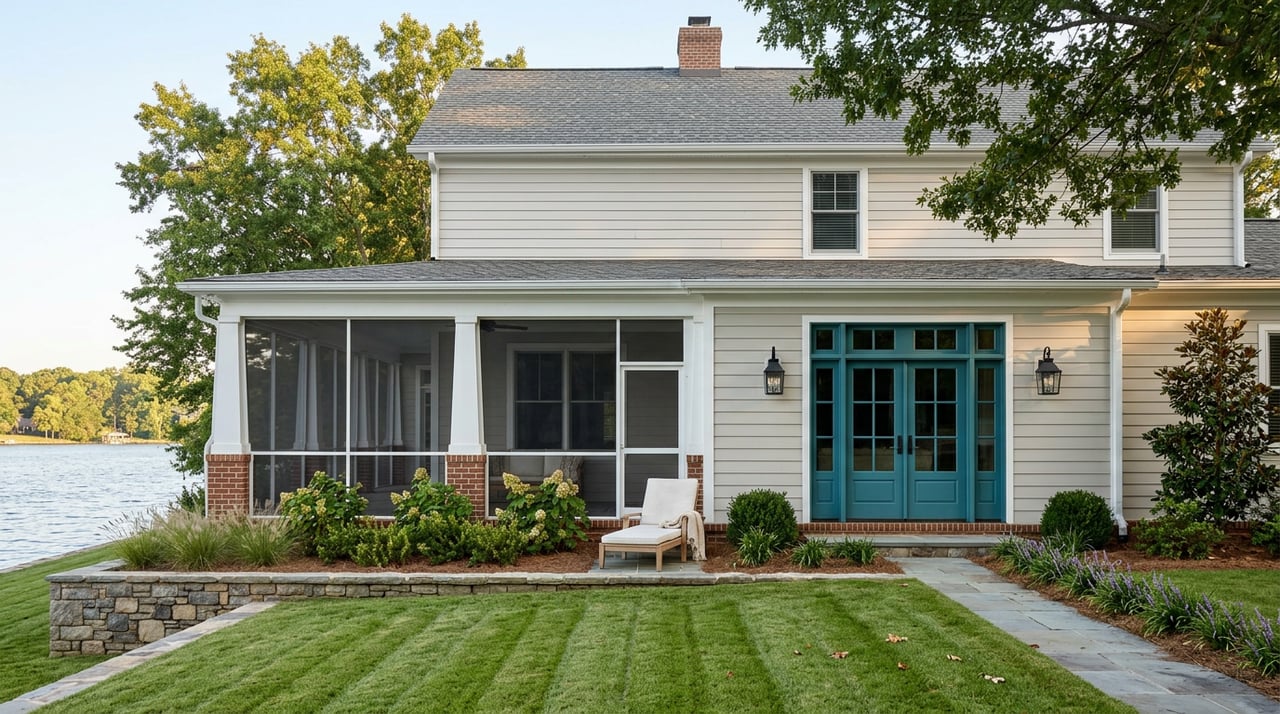
What Cornelius Waterfront Buyers Should Verify About the Dock Before They Write the Offer
July 23, 2026
July 23, 2026
The listing photo shows a dock. The MLS sheet lists a slip number. The seller mentions a lift. None of that tells you what you are actually buying at the water. In Cornelius, the dock is a separately permitted structure on land Duke Energy owns, and the approval that governs it runs on a parallel track to your purchase contract, with its own timeline, its own inspector, and its own way of derailing a close.
The price tier you shop in on Lake Norman does not just change the house. It changes which of four fundamentally different dock rights structures you are acquiring, and each one carries a different verification path. Buyers who understand that before they sign are in a different negotiating position than buyers who learn it during due diligence.
Lake Norman is a hydroelectric reservoir. Duke Energy created it, and the utility manages the shoreline under a federal license from the Federal Energy Regulatory Commission. Your Cornelius property line ends at the full pond elevation, referred to on the lake as the 760 line, which represents 760 feet above sea level. Every structure at or below that line, including your dock, boat lift, seawall, and any riprap, sits on Duke's property under a lake use permit, not on yours.
That permit does not automatically transfer with the deed. Duke Energy's Lake Services division releases permit history only to the current owner of record, which means if a seller never transferred the permit into their own name after their own purchase, the transfer has to happen before Duke will even release documentation. On a hot listing with contingencies burning down, that timing collision is where transactions stall.
Two other authorities can also weigh in. Above the 760 line, the North Carolina Department of Environmental Quality reviews activity inside the Catawba River shoreline buffer, and Mecklenburg County Planning handles the building, zoning, and floodplain layer. For anything involving dredging or wetland impact, the U.S. Army Corps of Engineers joins the review. Duke's own review for a standard private dock typically runs four to twelve weeks. Layered projects extend to several months.
Cornelius homes were listed at a median of $599,000 in June 2026, according to Movoto, with a median of $308 per square foot. Waterfront homes across the broader Lake Norman market had a Q1 2026 median of $2,364,000. And in July 2026, a newly built estate at 20221 Regatta Island Drive listed at $18,999,000, setting a new town record. Those three numbers describe three different products, and the dock rights explain most of the gap.
| Price tier in Cornelius | Typical dock structure | Where the friction lives |
|---|---|---|
| Under $700K condo or townhome | Deeded boat slip inside a shared community pier such as Commodore's Landing, Admirals Quarters, or Villages at Harborside | Slip is titled separately with its own dimensions, lift capacity, and assessment history; HOA reserves for dock and seawall work matter as much as the unit condition |
| $700K to $2M single-family | Community-assigned slip, deeded slip a few doors down, or off-water home with lake access rights | Slip may be assigned as a limited common element and must convey with the house; verify it is not reassignable by board policy |
| $2M to $6M waterfront single-family | Private single-slip dock at the property, permitted to that parcel's shoreline classification | Shoreline classification and cove geometry, not lot size, govern whether a second slip, a roof, or a larger lift is even eligible |
| $6M and above peninsula estates such as The Peninsula, Point Largo, Flagship, or Regatta Island | Multi-slip private dock, potentially with covered structures and deep-water access | Every modification touches Duke, and any change to square-foot math from a roof or enclosure can trigger denial even when the footprint is unchanged |
The commodity read of "waterfront in Cornelius" collapses four different transactions into one line item. A $525,000 ground-floor unit at Commodore's Landing with deeded slip 63 is a completely different underwriting exercise than a $3.65M home on Whispering Oaks Drive with a private dock, and neither resembles the $19M Regatta Island transaction, where the permitting file is likely as thick as the survey.
The clearest illustration of how the permit runs on its own track comes from a documented Lake Norman case. Buyers closed on a lakefront home. During the routine post-closing permit transfer, Duke's inspector reviewed the original permit and identified that a dock topper, an upper covered structure, had once been part of the approved dock and had been removed by a prior owner without authorization. Because the change to the footprint was never re-permitted, Duke required the entire dock to be removed at the new owner's expense.
The buyer had inspected the house. The buyer had inspected the dock as it stood. The buyer had not confirmed that the dock as it stood matched the permit on file. Nothing about that scenario is unique to a particular price tier. It is available at $500K and at $5M.
Because Duke will not release permit history to a prospective buyer, the sequence has to run through the listing side. Melody structures it this way for buyers writing on Cornelius waterfront:
The order matters. A buyer who verifies the permit is in the seller's name first avoids a three-week detour later. A buyer who confirms the shoreline classification before writing knows whether the extra slip they want is a real option or a fantasy.
The pattern in Cornelius transactions is consistent enough to name:
None of these are dealbreakers on their own. Each is a dealbreaker if it surfaces at day 12 of a 14-day due diligence window instead of before the offer went in.
Can financing be affected by an unpermitted dock? Yes. Lenders may require proof that docks and lifts are legal and usable when those features support the appraised value. Open violations or removal orders can slow or stop underwriting. Insurance carriers may exclude unpermitted structures.
How long does a standard Duke permit review actually take? Duke's own review for a straightforward private dock runs four to twelve weeks. Anything triggering NCDEQ, Army Corps, or dredging review extends the timeline to several months.
Is a dock plate on the pier the same as a permit? No. The plate confirms a permit exists at some point in the record. Only the permit file itself confirms whether the current structure matches what Duke approved. That distinction is exactly where the removed-dock-topper case originated.
Every waterfront transaction in Cornelius is really two transactions, one for the house and one for the dock, and the second one runs by rules the first one does not. If a specific address is on your list, or if you are trying to compare a condo with a deeded slip against a private-dock home at a higher tier, a pre-offer review of the permit posture is the single highest-leverage step available to you. Melody Fuhr works alongside Duke's Lake Services requirements and the parallel county, state, and federal reviews so the water side of your purchase is underwritten with the same care as the house.
Schedule a White‑Glove Consultation to walk through your Cornelius shortlist, address by address, before the offer goes in.
Stay up to date on the latest real estate trends.
July 23, 2026
July 23, 2026
July 23, 2026
July 16, 2026
July 9, 2026
July 2, 2026
June 18, 2026
June 11, 2026
June 4, 2026
Get assistance in determining current property value, crafting a competitive offer, writing and negotiating a contract, and much more. Contact me today.